
01
Deep research
Primary-source analysis of companies and sectors, not recycled sell-side notes. We build our own view from the ground up.
 Begin the conversation
Poorman's Paradox Capital combines deep research, quantitative discipline, and AI-enhanced insight to uncover long-term value in specialized sectors.
Speak with our founder
Our approach
Most managers follow the crowd. We look where the crowd isn't looking, in the sectors where the next decade gets built.
Begin a conversation


WHAT WE REJECT
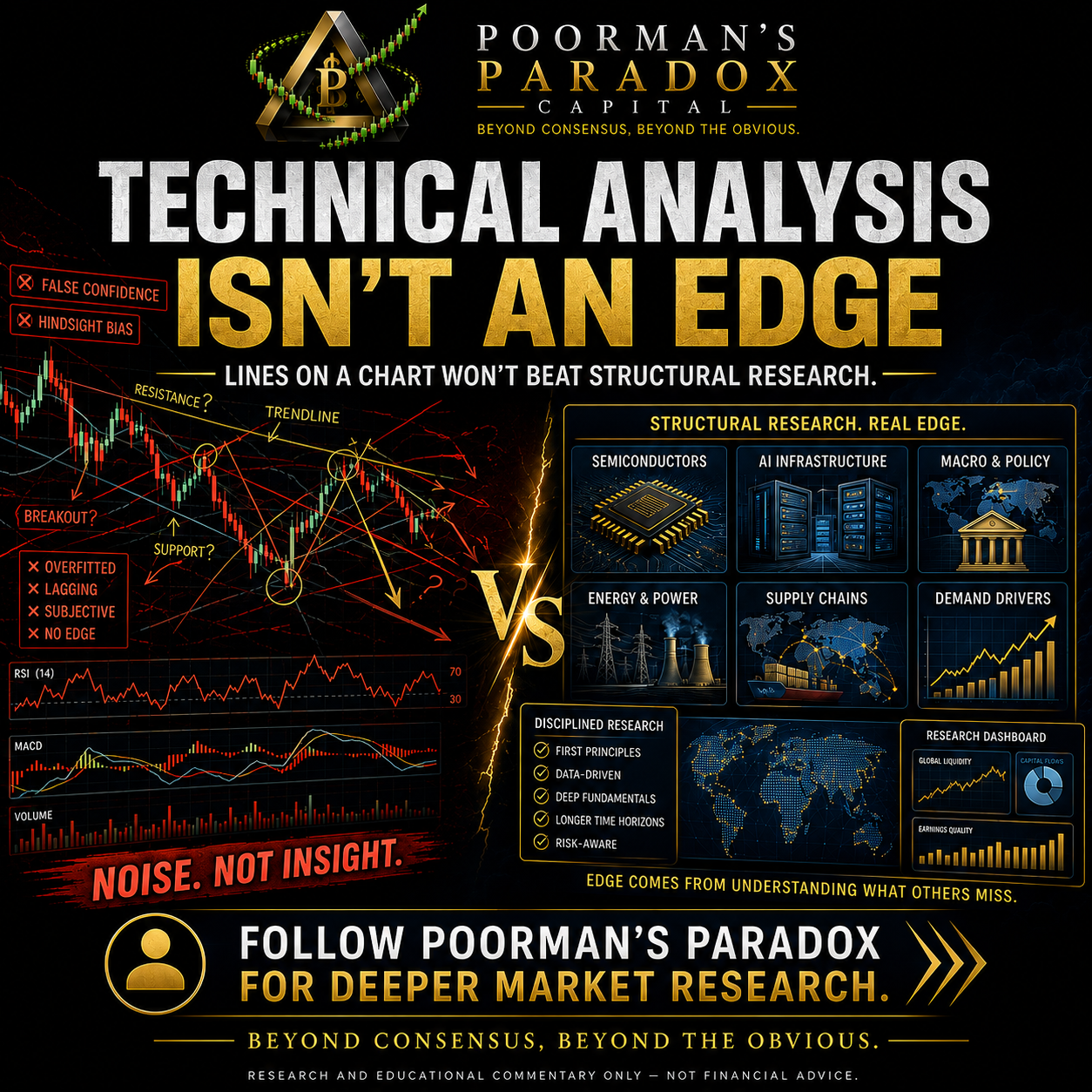
Technical analysis is financial astrology for people who confuse looking at a chart with conducting research.
Anyone who follows RSI, MACD, Fibonacci retracements, moving-average crosses, candlestick formations, “support,” or “resistance” as a predictive investment framework is ignorant of the evidence and uneducated in statistical inference. That is not disagreement—it is methodological illiteracy.
Kuang, Schröder, and Wang tested 25,988 technical strategies across ten emerging foreign-exchange markets. Standard tests produced hundreds to thousands of apparently profitable rules. After correcting for data-snooping bias, almost all of the alleged profits disappeared.
Bajgrowicz and Scaillet revisited technical-trading rules on the Dow Jones Industrial Average from 1897 through 2011. Their persistence tests found that an investor could not have selected the future best-performing rules in advance. Even the in-sample performance was completely offset by low transaction costs.
Park and Irwin evaluated technical-trading rules across 17 U.S. futures markets from 1985 through 2004. After correcting for data-snooping bias, the best rules produced statistically significant economic profits in only two of the 17 markets.
Your chart does not predict the market. It redescribes what already happened and lets hindsight, confirmation bias, multiple testing, and overfitting cosplay as intelligence.
Price, volume, volatility, liquidity, and positioning can inform legitimate regime and market-microstructure research. Arbitrary lines, magical ratios, and indicator thresholds do not become causal evidence because a self-appointed guru put them on a candlestick chart.
Publish the frozen rule, every failed variation, true walk-forward results, realistic slippage and costs, benchmark comparison, and an audited live record—or stop calling hindsight “alpha.”
Internal review discipline
These cards describe the developing internal process. They are not attributed opinions, client testimonials, or performance claims.
Every thesis records the conditions that support it and the observations that would weaken or invalidate it.
Scenario ranges and sensitivity checks make uncertainty visible instead of hiding it behind a single forecast.
A monitoring record tracks new evidence and requires the thesis to be revisited as conditions change.
Our discipline
We pursue asymmetric opportunities through a disciplined, repeatable process built on deep research and quantitative analysis.
Deep research, quantitative discipline, behavioral edge, and AI insight.
Observe, research, model, challenge, form a view, evaluate, and monitor.
Semiconductors, aerospace, and emerging technology drive the research.
Each thesis keeps its evidence, assumptions, risks, and review history together.

We're pre-launch and listening. Reach out to discuss how our research-driven approach could find asymmetric opportunities for you.
How we work
Through a disciplined process that pairs deep sector research with quantitative and behavioral analysis, we aim to identify long-term value where market perception diverges from economic reality.
Frequently asked
Practical answers about the developing research process and the limits of the current pre-launch firm.
Email your questionWe begin with deep fundamental research, then layer in quantitative models and behavioral analysis. Each idea is challenged from several angles before it earns conviction.
We look for situations where market perception diverges from long-term economic reality, then model the potential upside and downside of that gap.
AI can help organize information and examine patterns. We check its outputs against primary sources; it does not independently validate a thesis.
Rapid change can create unusually wide gaps between perception and reality. Disciplined research matters most where opinions are loudest.
We are building the firm deliberately and refining the research process. No advisory service is currently available, and the firm is not accepting client capital.
Evaluation follows the full process: observe, research, model, challenge, form a view, then continue monitoring. Patience is part of the discipline.